


QA/QC & QP Statement
QA/QC
Detailed Quality Assurance (“QA”) and Quality Control (“QC”) Protocols
Drill hole positioning, orientation and length is determined via data interpretation on historical drill hole sections as well as in our current 3D model, based on the objectives of confirming continuity of the known higher grade gold mineralization near surface, at depth and along strike, and to discover new gold mineralization, all of which could have a significant positive impact on the potential for increasing the mineral resources at Douay.
Drilling is mostly done on pre-defined drill hole sections, ensuring appropriate drill hole spacing between holes and along parallel sections. In the past, drill holes were positioned in the field following current established standards by azimuth orientation and dip with a hand-held or fixed GPS and compass for accuracy. The company now uses a gyrocompass to align drill rigs more accurately.
Originally, a single or multi-shot reflex orientation system was used to measure drill hole deviation, especially in areas of thicker overburden and magnetic rocks. A gyroscopic instrument is now used with closer measurement spacing (8-15m intervals) at the top of the hole, and more broadly spaced (about 30m) further downhole. Drill holes may be oriented a few degrees counterclockwise of the intended azimuth to ensure drill holes will follow the intended section.
Prior to and during drilling, a Qualified Geologist verifies the exact position of individual drill holes. A down-the-hole deviation test close to the overburden-bedrock interface , to ensure the drill hole has not deviated excessively, and that it remains on course for its intended target depth. To ensure the deviation of the hole is kept to a minimum, controlled drilling is applied for deeper holes, and extra precautions are used in drilling methods, such as longer drill stabilizers added at the request of a Qualified Geologist. As drilling was ongoing, the impact of drillhole deviation is monitored on 2D sections and in the company’s 3D model by a Qualified Geologist to insure adequate spatial positioning of the hole.
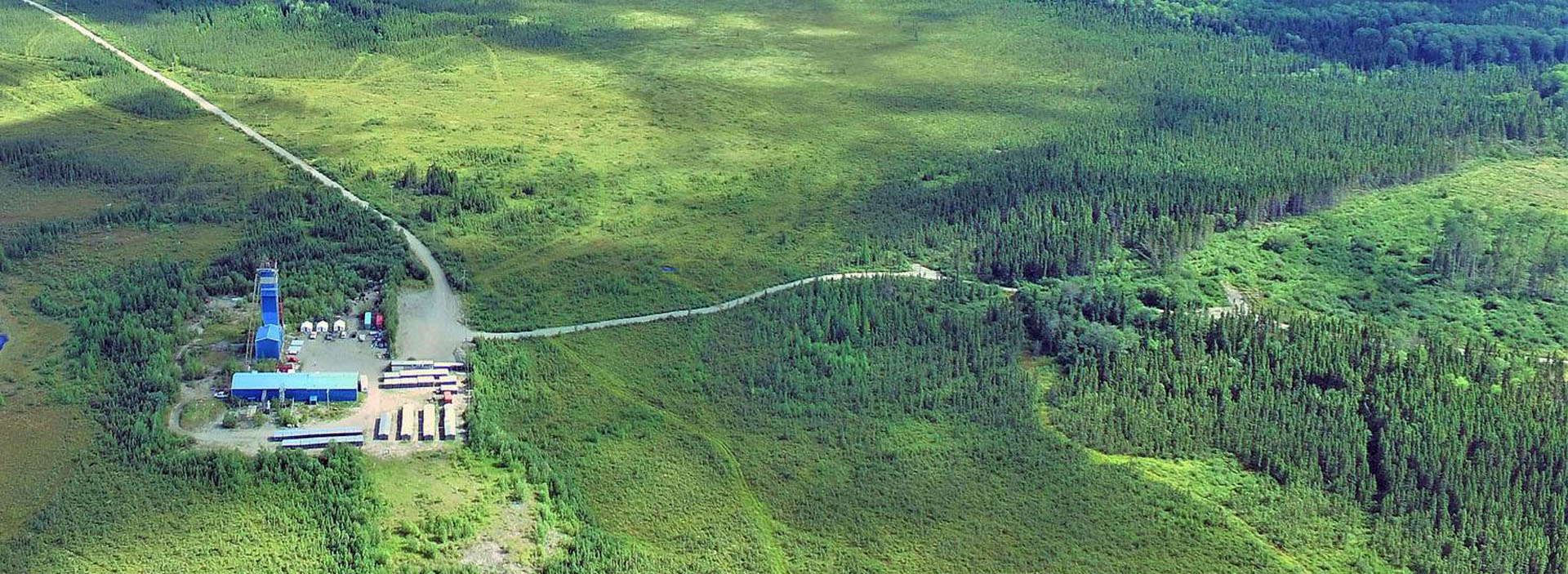
Core boxes are brought to the Maple Gold core logging and storage facility at the Douay Camp at the end of each shift by the drill contractor. Qualified Geologists examine the drill core to determine if the proposed target has been intersected and to ensure that drill core integrity is up to quality standards. . The Qualified Geologist instructs the drillers and/or foreman to either continue the drilling or stop the hole.
At the completion of each drill hole, the casing is left in place on instructions from the Qualified Geologist, and a numbered red cap is placed over the protruding casing. The numbered cap is usually accompanied by a 1.5-meter-long red metal spike topped by a red metal flag to indicate the location of the drill hole for future surface surveying.
Once core boxes have been received by Maple Gold at their core facility, a Qualified Geologist or Technician arranges core boxes on the core facility floor or temporary tables in numeric order from box 1 onwards. Core boxes are then opened, and interval blocks are checked for proper location. The Qualified Technician verifies these intervals using a measuring tape, making sure the correct depth is written on each block, and the final depth for each box is noted on the core box. The Qualified Technician will identify and tag each box with an aluminum metal tag writing the drill hole number and from-to intervals and will measure the Rock Quality Designation or RQD of the drill core and record the rock quality values.
The Qualified Technician takes conductivity and magnetic susceptibility (“MPP”) readings directly on the core at 50-centimeter intervals and records the measurements.
The Qualified Geologist describes the drill core features in the MX Deposit Logging system. While describing or logging the drill core, the Qualified Geologist marks intervals for core sampling. In the resource area core sampling is continuous, in exploration areas sampling can be selective, based on where alteration or mineralization is present. The Qualified Geologist marks the drill core with a colored wax pencil (usually in red) according to the actual intervals to be sampled and these continuous sampling lines are identified with a perpendicular line at the start and at the end of the intervals.
The Qualified Geologist fills out (with from-to intervals for each sampled interval) an AGAT Laboratory (Douay Gold Project) or ALS Laboratory (Joutel Gold Project and Morris VMS Project) numbered dual sample tag and staples this at the end of each interval to be sampled. Samples are now mostly taken at 1.0-meter intervals, however sample intervals can be adjusted to respect lithological and/or mineralogical contacts and isolate narrow (<1.0m) veins or other structures that may yield higher grades. Once all sample intervals have been chosen, photos of the wet and dry core are taken, usually four boxes at a time, with a white rectangular legend inscribed with the drill hole number, box numbers, and sample intervals.
The Qualified Technician saws the core of the sample intervals in half, being properly oriented with a cut-line marked by the Qualified Geologist. One-half of the core is kept as a witness sample, the other half is to be analyzed. The half of the dual sample tag for each interval is stapled to the bottom of the core box at the end of each sampled interval. One-half of the sampled intervals is bagged and tagged with one of the dual sample tags from AGAT Laboratory (Douay Gold Project) or ALS Laboratory Group (Joutel Gold Project and Morris VMS Project). Individual sample bags are sealed and placed into shipping pails and/or nylon shipping bags, sealed and marked with the contents. The samples are delivered by Maple Gold personnel in batches to the AGAT Laboratory (Douay Gold Project) or ALS Laboratory Group (Joutel Gold Project and Morris VMS Project) facilities in Val-d’Or, Quebec, for processing, crushing, pulverizing and analysis.
For Quality Control, the Qualified Geologist and Qualified Technician prepare sample duplicates from a quarter split of the half-sampled core. The method is to split ¼ core of the original sample leaving ½ core remaining as witness in the core box. The results are reconciled with other ½ core samples by averaging the two ¼ field duplicate split results - the average of the two ¼ splits should be comparable to a sample of the same ½ core.
Blank samples usually consist of a homogenous marble that is known to contain only background metal values. Both low-grade and high-grade rock standards are also inserted into the sample stream, Insertion frequency follows industry-standard practice of at least 5% total (we use 6.5%) QA/QC samples including duplicates, standards, and blanks. Subsequently, about 5% of the sample pulps are re-analyzed by a different laboratory for control purposes. Multi-element major and trace element geochemistry is done approximately every 20 samples for rock type identification and alteration vectoring.
QP Statement
Unless otherwise stated, the scientific and technical data contained within this website was reviewed and approved by Ian R. Cunningham-Dunlop, P.Eng., B.A.Sc.., Executive Vice President, who is responsible for ensuring that the geologic information provided on this website is accurate and acts as a “qualified person” under National Instrument 43-101 Standards of Disclosure for Mineral Projects.
Pascal Lessard, geo., Vice President, Exploration, also acts as a “qualified person” under National Instrument 43-101 Standards of Disclosure for Mineral Projects for the Company. Mr. Lessard has reviewed and approved applicable scientific and technical disclosure on this website within his areas of responsibility.
The most recent Mineral Resource Estimate and NI43-101 Technical Report was prepared for the Douay/Joutel Gold Project by Mr. Denis Decharte, P.Eng., an employee of the consulting firm SLR Consulting (Canada) Ltd. and independent of Maple Gold with an effective date of June 11, 2026. SLR Consulting has extensive experience in the mining industry and is leading consultancy firm.