


Joutel Gold Project
Overview & Highlights
The Joutel Gold Project is a 100%-owned, high-grade past-producing gold project in Québec, contiguous with the southern boundary of Douay along the Casa Berardi-Douay Gold Trend (Figure 1). Maple Gold acquired full ownership and legal title to Joutel in December 2024 following a joint venture restructuring with Agnico Eagle and completed the acquisition of the adjoining Eagle Mine Property from Globex Mining Enterprises Inc. in July 2026.
Joutel hosts the past-producing Eagle-Telbel mine complex, which operated from 1974 to 1993 and produced 1.1 million ounces of gold at an average grade of 6.5 g/t Au.
In April 2026, Maple Gold reported a maiden underground mineral resource at Joutel of 126,000 ounces of gold (Indicated - 0.9 Mt at 4.53 g/t Au) and 992,000 ounces of gold (Inferred - 7.5 Mt at 4.11 g/t Au). That resource sits alongside a deposit that mining never fully tested: drilling has now traced high-grade gold up to 450 m beyond the historical underground workings, and the system remains open along strike and at depth.
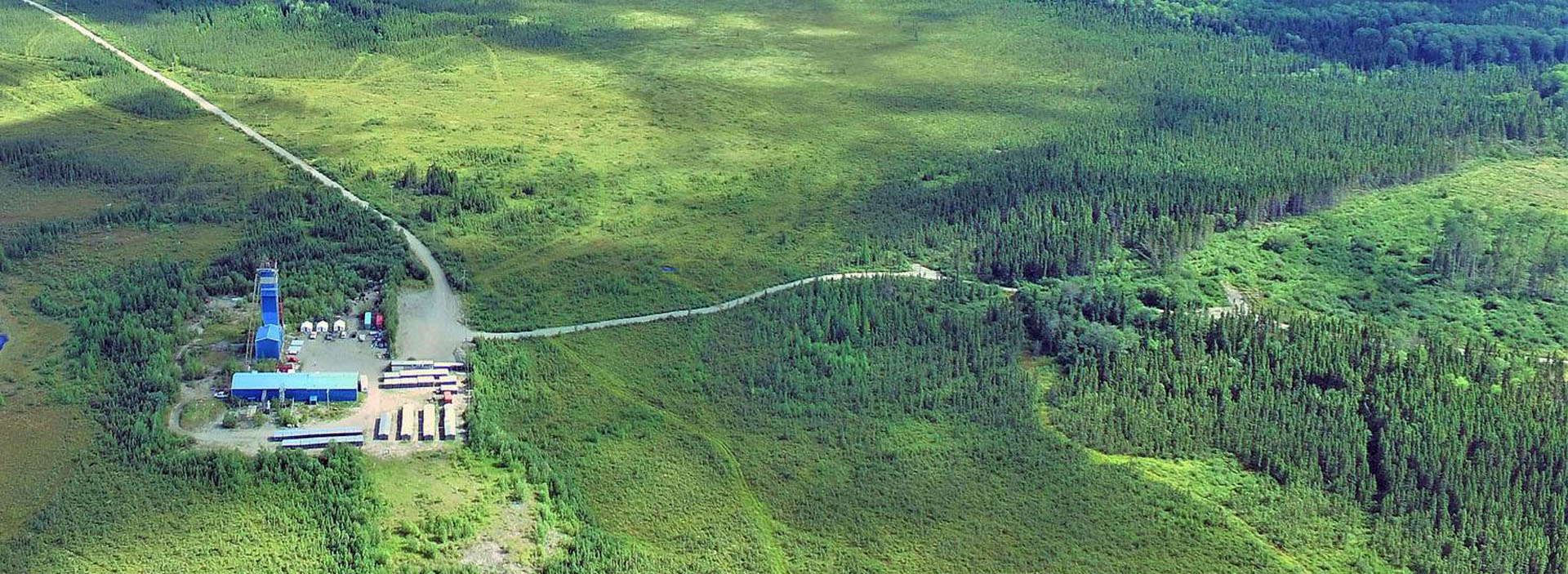
Joutel covers 39 km² approximately 70 km southwest of Matagami and 125 km north of Amos, and is accessible via Provincial Highway 109, which cuts across the project area. The project straddles the Harricana Break and its eastern continuation, the Joutel Deformation Zone, over 15.7 km of strike.
Its proximity to Douay, roughly 35 km by road, is a meaningful strategic advantage. Maple Gold is completing internal engineering work evaluating a centralized mill facility capable of processing material from both deposits.
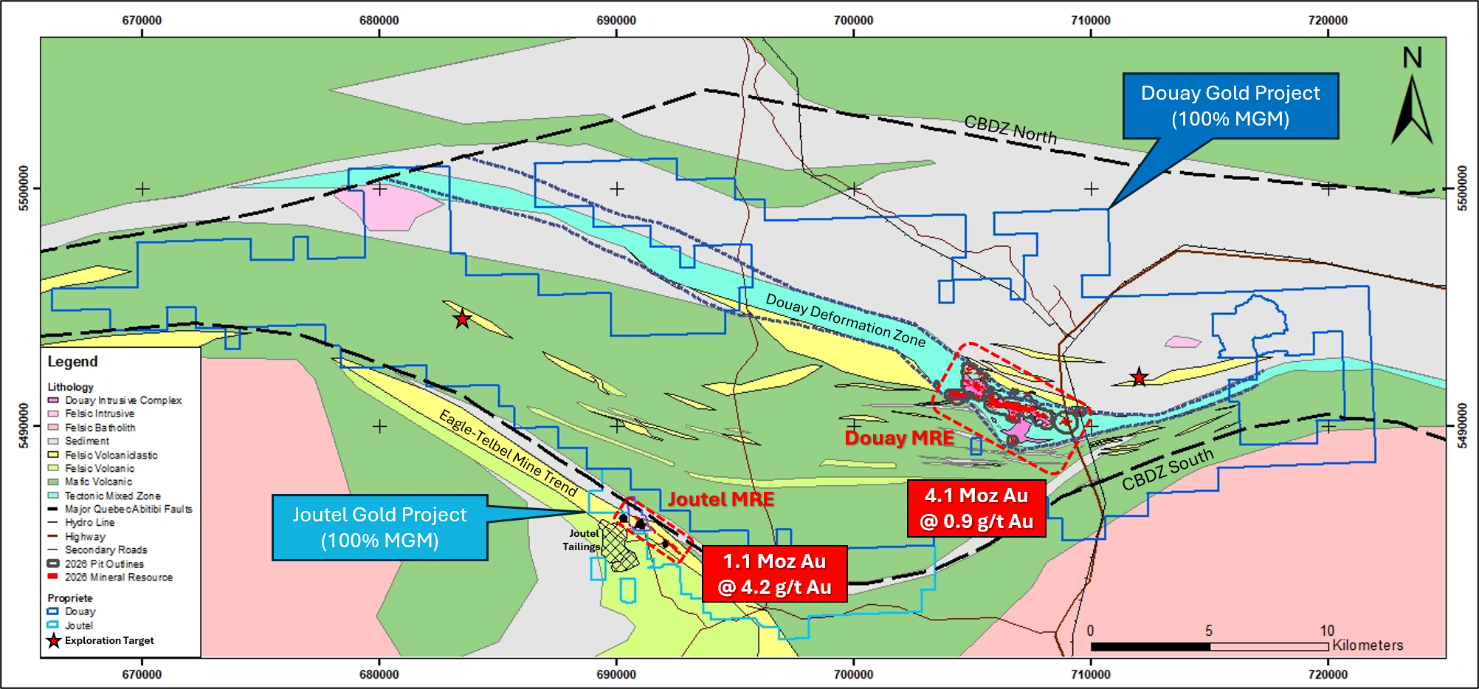
Figure 1: Regional Geology Map of the Douay/Joutel Gold Project highlighting the 2026 MRE Areas and Regional Targets
History
In 1962, Equity Exploration staked the original claims in the Joutel area, focusing its work on the search for base metals and drilling coincident ground magnetic (Mag) and electromagnetic (EM) anomalies. In 1966, Eagle Gold Mines Ltd. acquired Equity Exploration and carried out underground development on a gold-bearing pyrite deposit that had been identified by Equity which became the Eagle Mine. In 1971, the adjoining Telbel property was acquired. In 1972, after the merging of Agnico Mines Limited and Eagle Gold Mines Ltd., mining development resumed at the Eagle Mine and in 1974 the first gold was produced by regular and sustained production.
Historical Gold Production
Joutel hosts the historical underground Eagle Mine (Plate 1), Agnico Eagle’s first gold mining operation, which together with the Telbel Mine and the Eagle West open pit / underground mine formed part of Agnico's past-producing “Joutel Mining Complex”. This operation produced approximately 1.1 Moz Au (from approximately 6.2 Mt of ore (6.8 st) at an average grade of 6.5 g/t Au) over a 20-year period between 1974 and 1993 during a significantly lower gold price environment (Note - production figures were provided by Agnico Eagle and are historical in nature).
The Eagle Mine had a production shaft that extended to approximately 950 m, with historical production beginning in 1974 before operations shifted to the Telbel Mine which had a production shaft reaching 1,200 m. Approximately 85% of the gold came from underground production (Eagle and Telbel Mines) and the remainder came from the shallow Eagle West open pit, located west-southwest of the Eagle shaft, which reached a depth of 60 m and an associated underground ramp from pit bottom which reached 140 m. The total lateral extent of the Eagle-Telbel historic underground workings is estimated to be ~60 km (determined by in-house calculation).
Following the Joutel Mining Complex’s closure in 1993, the Eagle-Telbel UG workings and Eagle West open pit/ug ramp were allowed to flood and site activities shifted into a phased reclamation and environmental stabilization process. The mine site was remediated, and environmental monitoring of the site and Eagle tailings facility was initiated. Agnico Eagle maintains 100% ownership (surface and mineral) for Eagle Tailings Claim (the ‘Eagle Tailings Excluded Area”) and is responsible for ongoing environmental monitoring and remediation.
Following closure in 1993, work at Joutel shifted to reclamation and the project sat largely dormant. Historical drill and stope records remained in paper form until a major digitization effort in 2021 converted them into a modern 3D geological model, the foundation for the exploration work underway today.
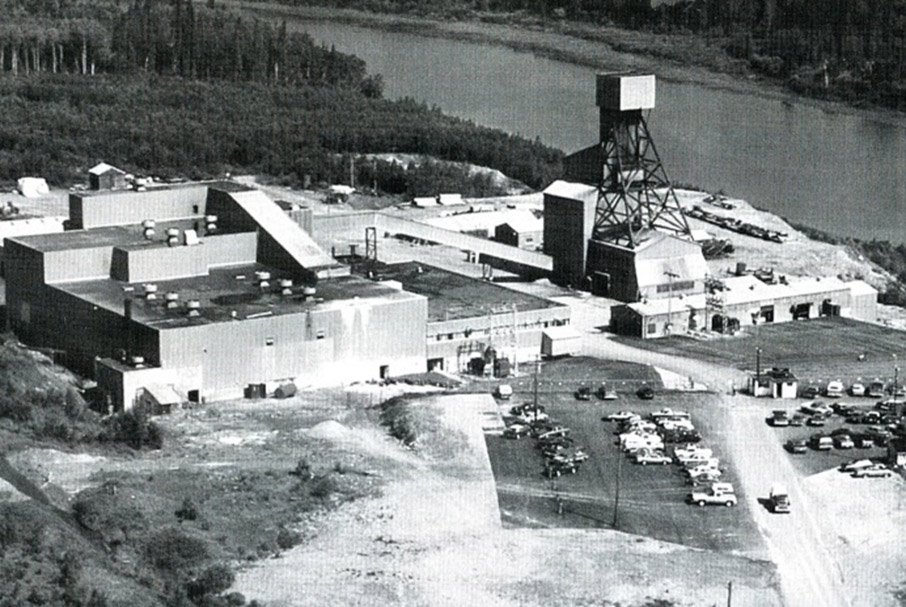
Plate 1: Joutel Gold Project – View of the Eagle Mine which produced from 1974 to until 1993
Geology & Mineralization
Joutel overlaps the intersection of the northwest-southeast Harricana Deformation Zone and the east-west Joutel Deformation Zone, which together mark the southern limit of the Casa Berardi Deformation Zone (Figure 2).
The uppermost cycle of the Joutel Volcanic Complex, known as the Mine Sequence, consists of a thick footwall rhyodacitic to dacitic pyroclastic unit overlain by interbedded clastic and chemical sedimentary units, felsic pyroclastics and mafic flows. Within this sequence, a continuous near-vertical horizon known as the Main Iron Carbonate Horizon (MICH), marked by strong ankerite alteration and quartz-carbonate veining, hosted the bulk of historical gold production.
Gold at Eagle, Telbel and Eagle West occurs in steeply dipping to near-vertical semi-massive pyrite-iron carbonate horizons cut by quartz and quartz-dolomite veins. Base metal values are low. Both mines sit within a subvertical northwest-southeast striking unit of the Mine Sequence, which hosts several high-grade ore shoots plunging at roughly 55° to 60° to the southeast.
Two additional iron carbonate units, the North Mine and South Mine Horizons, have been identified as secondary exploration targets, and gold has also been intersected in footwall micro-gabbro and hanging wall felsic tuff units, broadening the target set beyond the MICH itself.
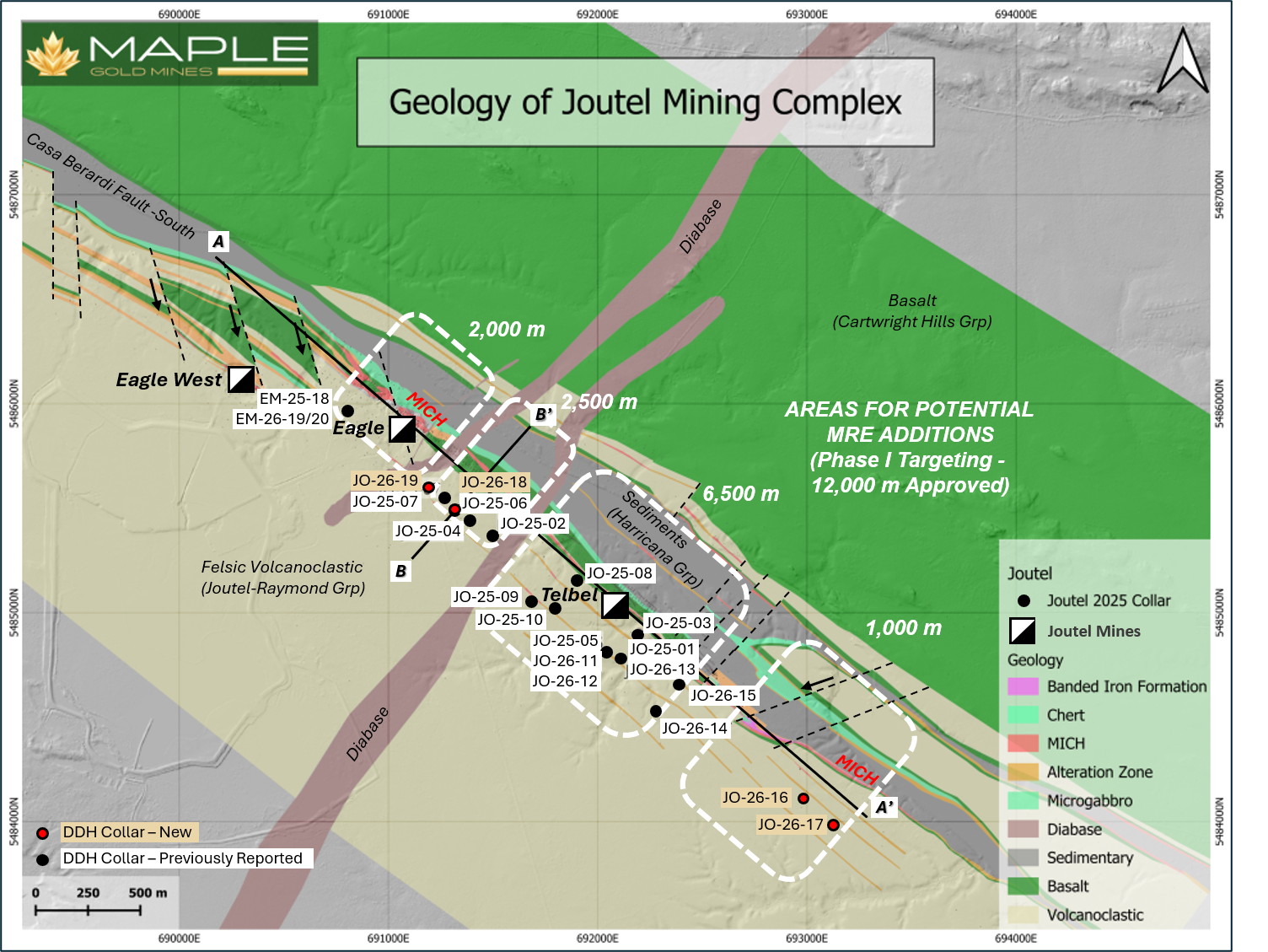
Figure 2: Plan view map of the Joutel Mining Complex and Eagle-Telbel Area highlighting the MICH Horizon, Drill Target Areas, and 2025/2026 Completed Drill Holes
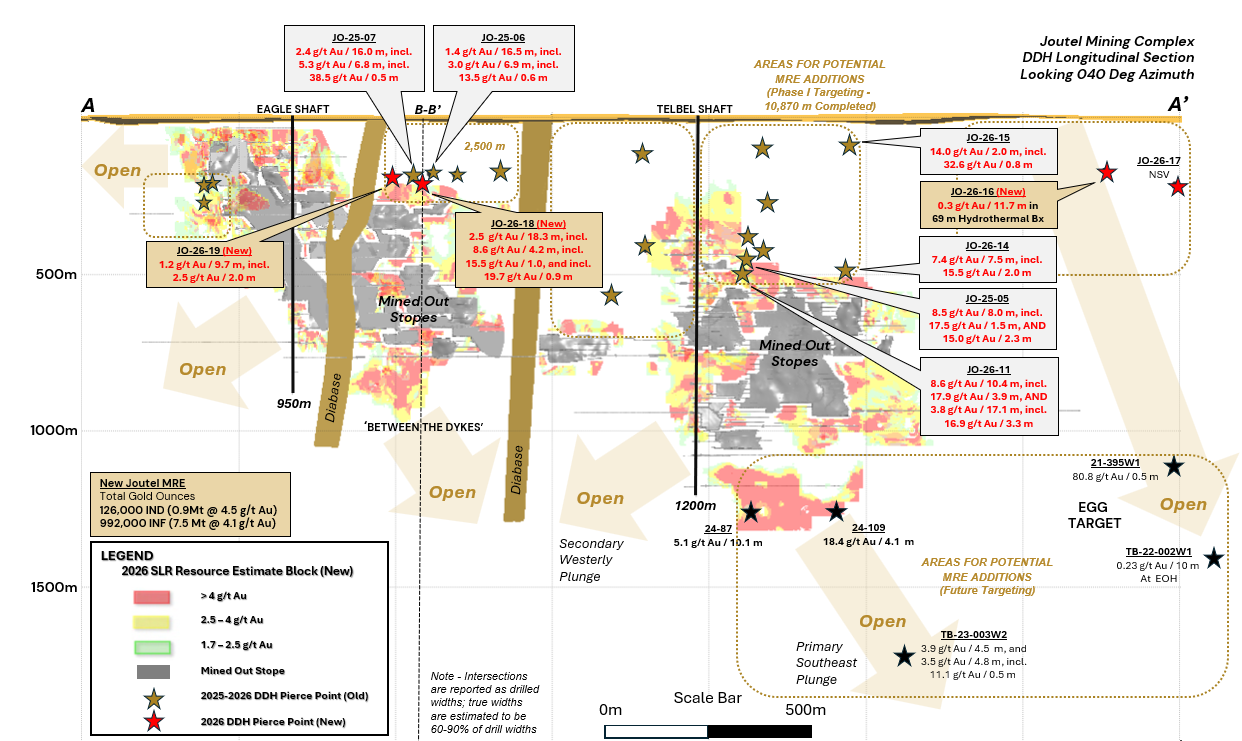
Figure 3: Longitudinal section of the Joutel Mining Complex showing historical Eagle-Telbel underground workings and mined-out stopes, 2026 MRE block model, and selected drilling results not included in the 2026 MRE. Looking North East.
Exploration & Drilling
Maple Gold completed 22 drill holes totalling 10,870 m at Joutel during its inaugural winter campaign, targeting extensions of mined-out high-grade mineralization within the MICH above and beyond the historical Eagle-Telbel workings. These 22 drill holes are not included in the 2026 MRE and represent an opportunity for the next MRE update (Figure 3).
Recent highlights include:
- 6 g/t Au over 4.2 m within 2.5 g/t Au over 18.3 m (JO-26-18)
- 6 g/t Au over 0.8 m within 14.0 g/t Au over 2.0 m (JO-26-15), confirming gold in the footwall micro-gabbro
- 5 g/t Au over 2.0 m within 7.4 g/t Au over 7.5 m (JO-26-14), in a 250 m step-out above the eastern extent of the Telbel workings
- 3 g/t Au over 1.3 m within 2.7 g/t Au over 10.2 m (JO-26-13)
(See news releases dated August 10, 2026, June 3, 2026, and February 26, 2026.)
An expanded, fully funded 25,000 m fall 2026 drill campaign is now underway, focused on near-surface resource growth and targeted resource conversion. The $9 million program is funded from the Company's treasury and is expected to generate a steady flow of results through the remainder of 2026, supporting future resource updates and development studies.