


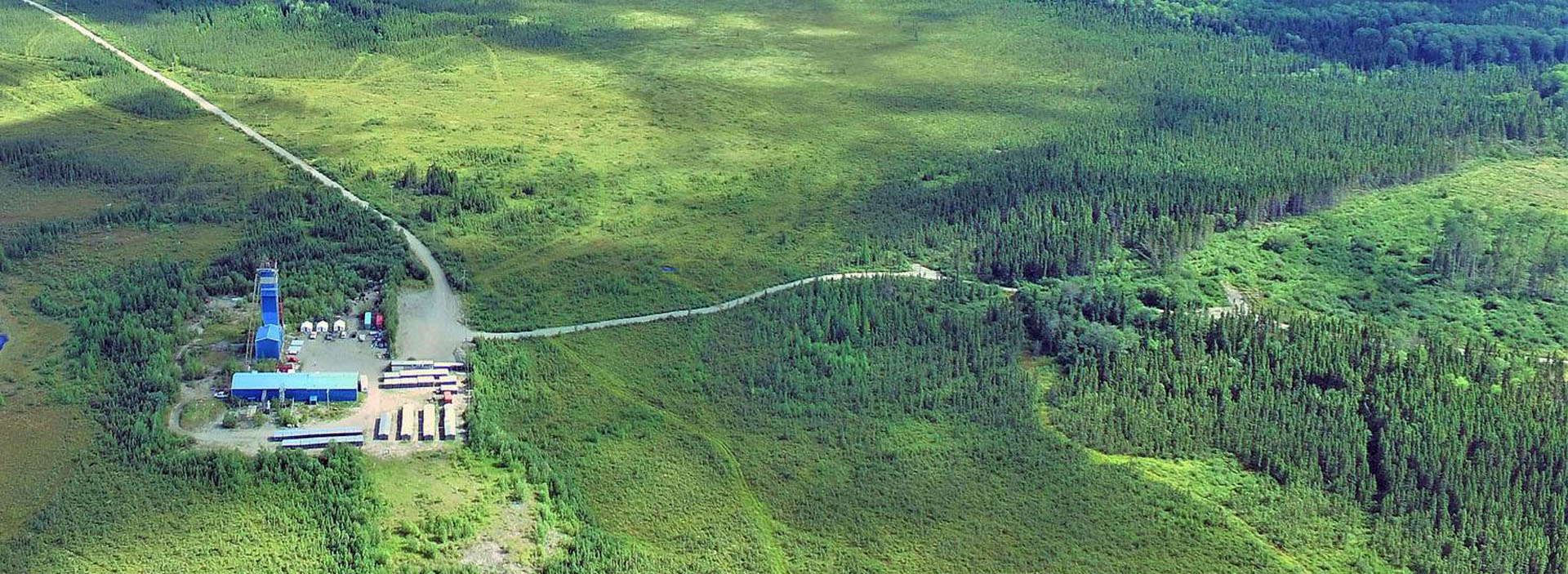
Joutel Gold Project
Overview & Highlights
The Joutel Gold Project (“Joutel”) is a high-grade past-producing gold project in Québec, Canada, strategically located along the Casa Berardi-Douay Gold Trend. In December 2024, the Company acquired full ownership and legal title to Joutel following a joint venture restructuring with Agnico Eagle.
Joutel hosts the past-producing Eagle-Telbel mine complex, which operated from 1974 to 1993, producing 1.1 million ounces of gold at an average grade of 6.5 g/t Au during a period of much lower gold prices. The project spans 15.7 km along the Harricana Break (Casa Berardi South), a major gold-bearing structure with strong exploration potential.
The Company has advanced Joutel through extensive data compilation and modern geological modeling. A 3D geological and structural model developed in Q4 2021 identified high-grade gold targets beyond previously mined stopes at Telbel.
A year-long data review and compilation exercise in 2024 integrated historical drill core analysis and digitized data, refining geological and structural controls on gold mineralization. The modern 3D model confirms that the favourable geology hosting the Telbel deposit extends both along strike and at depth, while also identifying new target trends with limited prior drilling.
Location & Jurisdiction
Joutel spans 39 km², located approximately 70 km southwest of Matagami and 125 km north of Amos. The project is contiguous with the southern boundary of the Douay Gold Project and is accessible via Highway 109, which cuts across the project area.
Joutel straddles the Harricana Break and its eastern continuation, the Joutel Deformation Zone, over 15.7 km. See Figure 1 below for the location of Joutel and the Eagle-Telbel deposits relative to Douay.
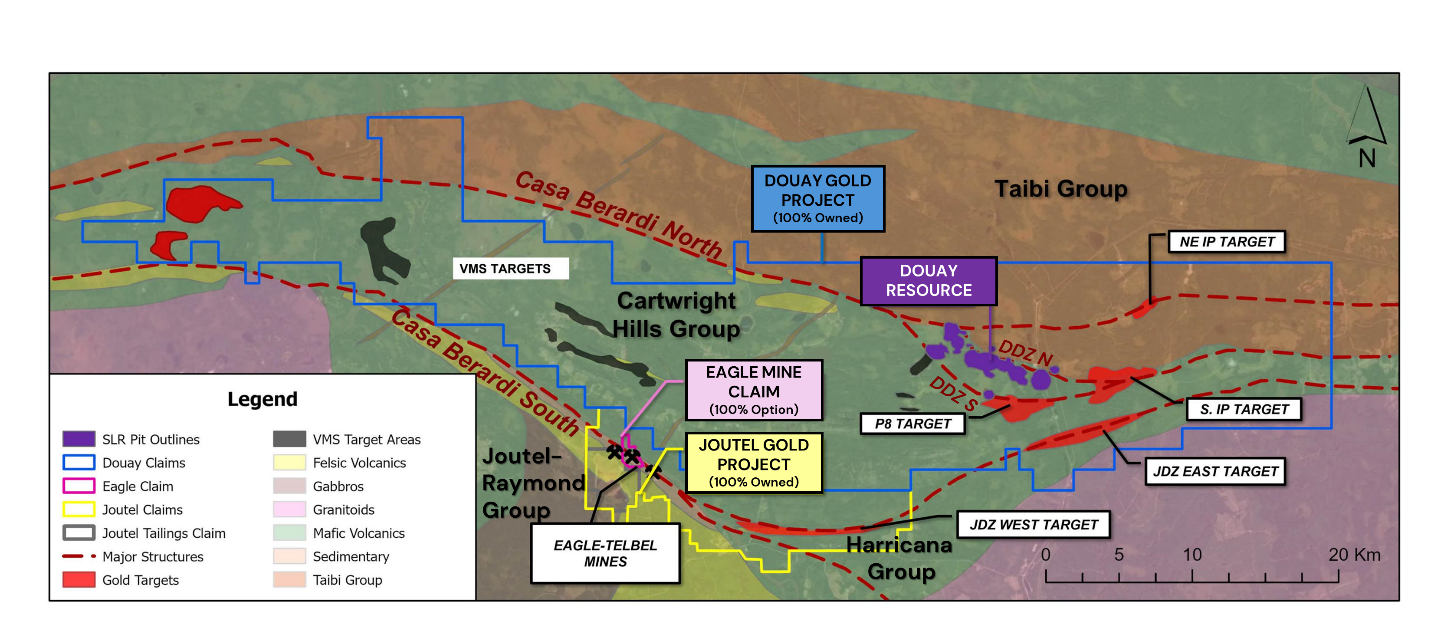 Figure 1: Plan view on regional base map showing outline of Douay/Joutel/Eagle property outline with Casa Berardi Deformation Zone, Douay resource area and Douay regional targets.
For general details on Québec’s infrastructure and mining jurisdiction, refer to the Company’s presentation or the Douay Gold Project page.
History
Gold exploration at Joutel began in 1962, with the first intercepts discovered between 1962 and 1964 through drill testing of magnetic and electromagnetic anomalies. The Eagle-Telbel mining camp, which operated from 1974 to 1993, produced 1.1 million ounces of gold at an average grade of 6.5 g/t Au (Plate 1). Mining at Telbel focused on a single zone between the 600- and 1,000-metre levels, accessed via a drift from the Eagle Mine at approximately 750 metres.
Following the mine’s closure in 1993, work at Joutel shifted to reclamation. For decades, historical drill and stope data remained in paper format until a major digitization effort in 2021 transformed these records into a modern 3D geological model, paving the way for new exploration targeting.
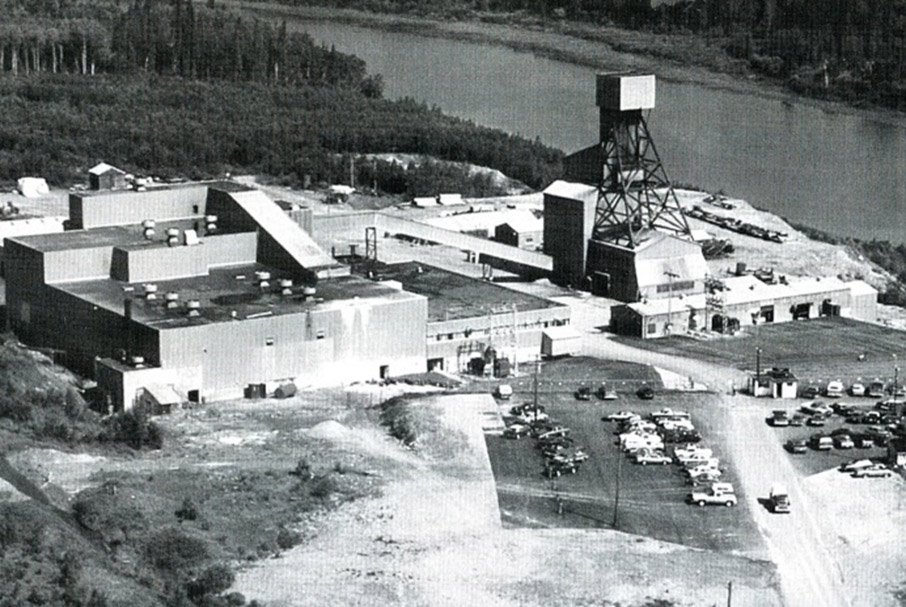
Plate 1: Eagle-Telbel Mine Complex
Property Geology & Mineralization
The Joutel Gold Project overlaps the intersection between the northwest-southeast Harricana Deformation Zone and the east-west Joutel Deformation Zone, which collectively mark the southern limit of the CBDZ (Figure 1 and Figure 2).
In the Joutel project area, the uppermost cycle of the Joutel Volcanic Complex, called The Mine Sequence of the Joutel Camp, consists of a thick footwall rhyodacitic to dacitic pyroclastic unit, overlain by interbedded clastic and chemical sedimentary units, fine to coarse felsic pyroclastics, and mafic flows. Within this sequence, a continuous near-vertical horizon termed the Main Iron Carbonate Horizon (MICH), with strong iron carbonate (ankerite) alteration and quartz-carbonate veining, hosted the bulk of past gold production (Figure 2).
In the Joutel mine area and to the northwest, the Mine Sequence is overlain by the Harricana Sedimentary Sequence, which is in fault contact with the Cartwright Mafic Volcanic Sequence to the north.
To the southeast, the Harricana Sedimentary Sequence thins rapidly, and a complex sequence of predominantly felsic tuffs (C-Horizon hanging wall - North Mine Horizon footwall), with various clastic and chemical sediment units, occurs between the Harricana Sedimentary and Cartwright sequences. Two iron carbonate units, North Mine and South Mine Horizons, have also been identified as secondary exploration targets.
All sequences are cut by late major east-northeast to northeast trending Proterozoic diabase dykes.
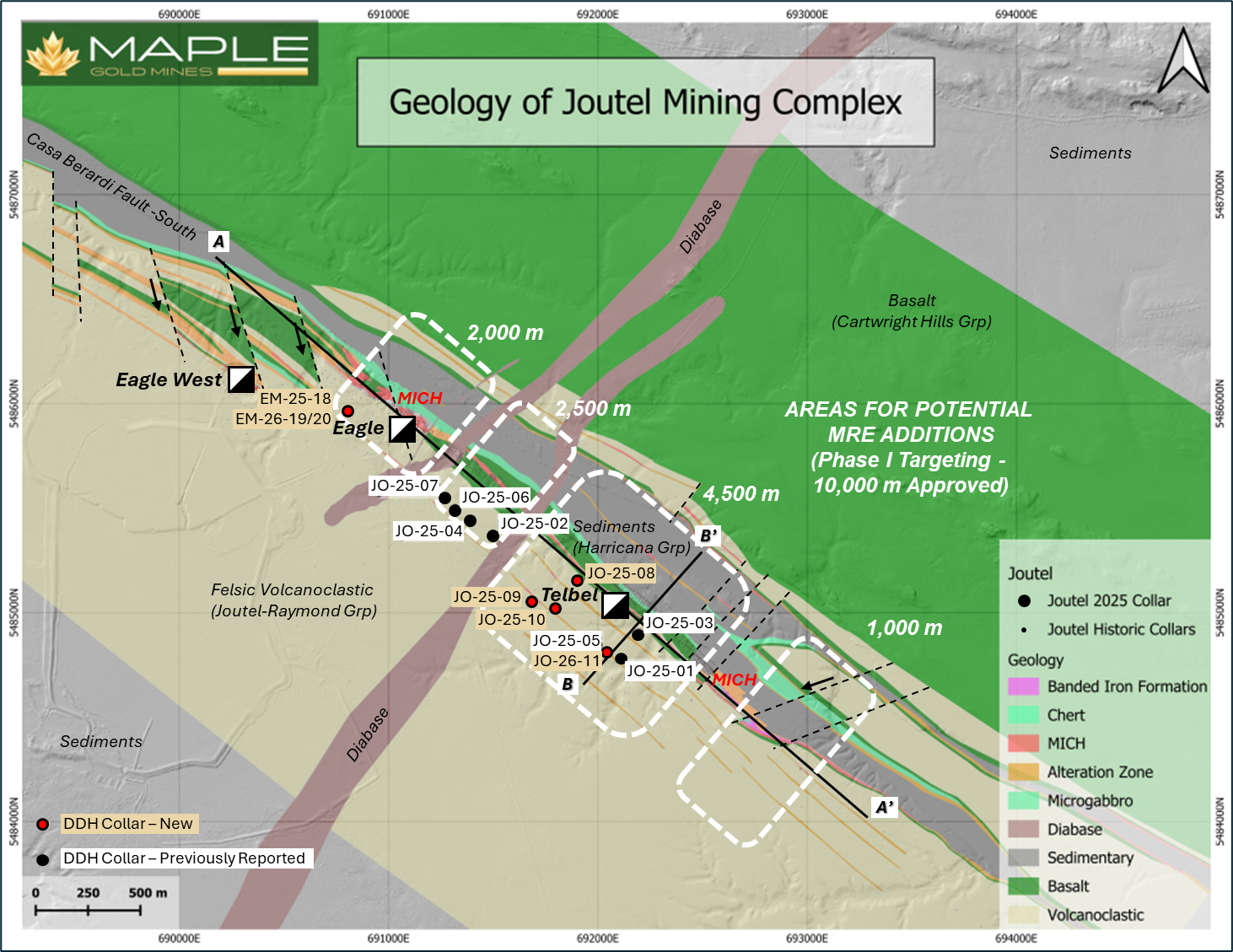
Figure 2: Plan view map of the Eagle-Telbel Area highlighting the MICH Horizon, Drill Target Areas, and 2025/2026 Completed Drill Holes
The gold mineralization found at Joutel is mostly consistent within its three mains areas, Eagle, Telbel and Eagle West. Gold mineralization exploited at the mines was hosted in steeply dipping to near-vertical semi-massive pyrite-iron carbonate horizons cut by quartz and quartz-dolomite veins and veinlets. Base metal values are low in the mine areas. Quartz-carbonate veinlets in footwall tuffs and carbonate-silica-pyrite alteration zones within the Mine Andesite locally carry significant gold (over 1 g/t), and the top of the Harricana Sedimentary Sequence can also occasionally carry gold.
Both Eagle and Telbel mines are found within a subvertical northwest-southeast striking unit of the Mine Sequence, which hosts several high-grade principal ore shoots plunging at about 55° to 60° to the southeast (Figure 3).
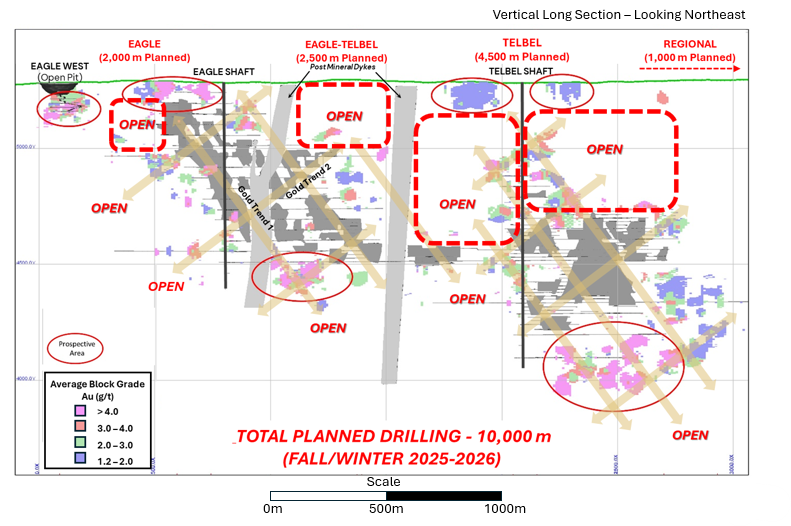
Figure 3: Joutel longitudinal section with Eagle-Telbel Underground Workings & Mined-Out Stopes (in grey) and 2025-2026 Completed Drill Holes with Significant Assay Results. Looking Northeast.
Recent Exploration Highlights
- Drill hole JO-26-11 returned two (2) high-grade gold intervals including 17.9 grams per tonne of gold ("g/t Au") over 3.9 m within 8.6 g/t Au over 10.4 m and 16.9 g/t Au over 3.3 m within 3.8 g/t Au over 17.1 m, located approximately 50 m above the Telbel Mine workings.
- JO-26-11 gold intercepts are located approximately 50 m below previously reported drill hole JO-25-05, which returned 8.5 g/t Au over 8.0 m (see news release dated February 26, 2026).
- In the Eagle Mine area, drill hole EM-26-19 returned two (2) intervals including 2.1 g/t Au over 12.9 m and 1.4 g/t Au over 17.0 m and drill hole EM-26-20 returned 1.1 g/t Au over 13.7 m.
- Current drilling at Joutel has extended high-grade gold mineralization up to 450 m beyond the historical Eagle-Telbel underground workings and the system remains open in multiple directions.
- Maiden Joutel mineral resource estimate ("MRE"), excluding current drilling, remains on track for delivery in H1 2026.
- Including the seven (7) holes reported today, the Company has now reported drill results for a total of 14 holes (~6,800 m) out of 48 holes (~21,800 m) completed to date as part of the Program, with additional drilling planned in 2026.
Joutel represents a high-grade past producer with significant exploration upside, leveraging modern geological modeling and new drilling to unlock its full potential.